Parsing the Visa Bulletin: What Your Priority Date Means
Your priority date is the filing date of your I-140 (or your PERM, for EB-2/EB-3). Here's how to read the Visa Bulletin to predict your wait.
The short answer: Your priority date is your place in the green-card line — usually the day your employer filed your PERM labor certification, or the day your I-140 petition was filed. The Department of State's monthly Visa Bulletin publishes cut-off dates; when your priority date is earlier than the cut-off, a visa is available and you can move forward.
[Updated July 2026] This evergreen guide now consolidates our monthly Visa Bulletin coverage into a single explainer. We refreshed the illustrative examples to the current bulletin — including EB-2 India reaching its annual per-country limit and going unavailable for the remainder of fiscal year 2026 — added the often-overlooked EB-3 "Other Workers" cut-off, and re-verified the two-chart mechanics (Final Action Dates vs. Dates for Filing) against the current Department of State Visa Bulletin and USCIS adjustment-of-status filing-chart guidance. Specific cut-off dates change every month, so always confirm today's dates against the current bulletin before you act.
The Visa Bulletin is a monthly publication by the U.S. Department of State (DOS) that provides critical information on the availability of immigrant visas (aka green cards). It is an essential tool for people seeking to immigrate permanently to the United States.
The Visa Bulletin helps manage the demand for visas by setting cut-off dates for oversubscribed categories and countries. This ensures that green cards are issued within the limits set by Congress. Each visa category is subject to an annual limit, meaning there is a fixed number of visas available per year for each category.
The differences in cut-off dates arise because some countries (like India and China for employment-based, and Mexico and the Philippines for family-based) have much higher demand for green cards than others, leading to backlogs and the need to impose cut-off dates to manage the allocation of available visas.
By providing a monthly update on visa availability, the Visa Bulletin offers predictability to applicants, allowing them to plan their immigration process more effectively. It helps nonimmigrant workers seeking permanent residency to estimate when they might be eligible to apply for adjustment of status.
Visa Availability: The Visa Bulletin lists the availability of immigrant visa numbers for family-sponsored and employment-based categories. It indicates whose Priority Dates are current in each category, meaning who is eligible to put in their green card application now. A visa number must be available before an applicant can proceed with their green card application.
Priority Dates: The priority date is typically the date when the immigrant petition was filed or when the labor certification was accepted. The applicant's priority date determines their place in line for visa processing.
Per-Country Limits: The Immigration and Nationality Act (INA) imposes a per-country limit on the number of immigrant visas that can be issued to nationals of any single country. This is to prevent any one country from dominating the allocation of visas. Many green card categories are numerically limited, meaning there is a cap on the number of visas that can be issued annually in each category. When the demand for visas from a particular country exceeds its per-country limit, that country becomes “oversubscribed,” and a cut-off date is established to manage the queue of applicants.
Oversubscription: When a category or country is oversubscribed, only applicants with a priority date earlier than the cut-off date may be issued visas. This is why the Visa Bulletin shows different cut-off dates for different countries, reflecting the varying levels of demand and backlog for each country. In some cases a per-country allocation is exhausted mid-year and the category is marked “U” (Unavailable) until the new fiscal year begins — which is exactly what happened to EB-2 India in the July 2026 Visa Bulletin, when its pro-rated annual limit was reached and no further numbers could be issued for the rest of fiscal year 2026.
Different Lists for Employment-Based and Family-Based Visas: The list of countries with specific cut-off dates differ between employment-based and family-based categories due to differences in demand patterns. For example, India and China have higher demand in employment-based categories, leading to longer backlogs for them compared to other employment-based applicants. For family-based green cards, Mexico and the Philippines have higher demand than other countries, so they wait the longest.
Compare the EB-2 India Backlog to Everyone Else
The gap between an oversubscribed country and everyone else can be enormous. Take the EB-2 category, which is for professionals with advanced degrees and persons of exceptional ability; it receives just over a quarter of the employment-based green cards each year (approximately 40,000 out of the 140,000 overall employment-based green cards). As an illustration of how wide the spread can get: as of the July 2026 Visa Bulletin, EB-2 was current for applicants born almost anywhere in the world — meaning a recent filer from Europe, South America, Africa, or Australia could move forward right away — while EB-2 China sat at September 1, 2021, and EB-2 India had reached its annual limit and gone unavailable for the rest of the fiscal year. China and India are the only two countries that have historically carried an EB-2 backlog longer than the rest of the world.
Compare the F1 Mexico Backlog to Everyone Else
The same pattern shows up on the family side. The F1 category is for the unmarried adult sons and daughters of U.S. citizens, and they share a pool of 23,400 green cards per year. To see the spread, consider a real monthly snapshot: in the July 2025 Visa Bulletin, the government was accepting family-based filings from F1 Mexico applicants who started their green card process by June 1, 2006, but an F1 applicant from Europe, South America, Africa, or Australia would only have had to have started their green card process 11 years later, by September 1, 2017, to be eligible to file. The Philippines is the only country besides Mexico that has historically carried a longer F1 backlog than everyone else.
For a prospective immigrant, understanding how their priority date affects their ability to proceed is crucial, as it determines when they can move forward with the final steps of their immigration process.
Introduction to the Visa Bulletin
The Visa Bulletin is a monthly publication released by the U.S. Department of State that serves as a roadmap for anyone navigating the green card process. It provides up-to-date information on the availability of immigrant visas for both family-sponsored and employment-based preference categories. For immigrant visa applicants, understanding the Visa Bulletin is essential, as it determines when you can submit your application and when you might expect your immigrant visa to be issued.
At the heart of the Visa Bulletin are two important charts: the Application Final Action Dates chart and the Dates for Filing Applications chart. The Application Final Action Dates chart shows when immigrant visas can actually be issued—meaning when your green card can be approved. The Dates for Filing Applications chart, on the other hand, tells you the earliest date you can submit your application and supporting documents, even if your green card cannot be approved just yet.
Key terms to know include your “priority date” (the date your petition or labor certification was filed), your “preference category” (the specific family or employment-based group you fall under), and “final action dates” (the cut-off dates that determine visa availability). By tracking these dates and understanding which chart applies to your case, you can better plan your next steps in the green card process.
Staying current with the monthly Visa Bulletin is crucial for all applicants, as it is the official source for updates on visa availability, changes in cut-off dates, and overall progress in the green card process. Whether you are applying through a family-sponsored or employment-based preference category, the Visa Bulletin is your essential guide to understanding when you can move forward with your immigrant visa application.
What is your Priority Date?
Your Priority Date is generally the date when your relative or employer properly filed the immigrant visa petition on your behalf with the U.S. Citizenship and Immigration Services (USCIS). If a labor certification is required, the Priority Date is the date the Department of Labor accepted the labor certification for processing.
The primary document that shows your Priority Date is the I-797 Approval Notice for your Form I-140, Immigrant Petition for Alien Worker. This notice will explicitly state the Priority Date, which is typically the date your employer filed the labor certification with the Department of Labor or, if no labor certification is required, the date the I-140 petition was filed with USCIS.
If a labor certification was required, the Priority Date is the date the Department of Labor accepted the labor certification for processing.
If you have multiple approved I-140 petitions with different Priority Dates, you are generally entitled to use the earliest Priority Date. This is known as priority date retention, and it allows you to retain the earliest date from any approved I-140 petition, provided there is no fraud, willful misrepresentation, or material error involved. However, under certain circumstances, such as cases involving fraud or material error, the Priority Date may not be retained or may be adjusted.
The earliest-established Priority Date is transferable to subsequent petitions, even if the initial petitioning employer withdraws the I-140 or the business ceases to exist, as long as there is no fraud or gross error.
Priority Date Retention: The ability to retain the earliest Priority Date is a significant advantage, especially for applicants from countries with long wait times. This retention is applicable across the different employment-based categories (EB-1, EB-2, EB-3) and is crucial for managing the timing of your application for adjustment of status or an immigrant visa.
Impact of Revocation or Withdrawal: Even if an I-140 petition is withdrawn by the employer or the business ceases to exist, the Priority Date can still be retained unless the petition was revoked due to fraud or a material error.
Which Category is Yours on the Visa Bulletin?
To determine which category you are in on the Visa Bulletin, you need to identify the type of immigrant petition filed on your behalf and the preference category it falls under. The Visa Bulletin is divided into two main sections: Family-Sponsored Preferences and Employment-Based Preferences. Each section lists various categories, each with its own set of priority dates.
Identify Your Petition Type
Family-Sponsored Preferences: If your petition is based on a family relationship, such as a Form I-130, Petition for Alien Relative, you will fall under one of the family-sponsored categories. These include immediate relatives of U.S. citizens and various preference categories for other family members.
Employment-Based Preferences: If your petition is based on employment, such as a Form I-140, Immigrant Petition for Alien Worker, you will fall under one of the employment-based categories. These include EB-1 for priority workers, EB-2 for professionals with advanced degrees or exceptional ability, and EB-3 for skilled workers, professionals, and other workers. These employment-based categories are used by foreign nationals seeking permanent residency through employment in the United States. For foreign national employees, the green card process is directly affected by visa availability and the movement of priority dates, which can impact the timing and progression of their immigration status.
Look at Your Approval Notice
The I-797 Approval Notice for your petition will indicate the specific category under which your petition was approved. This document is crucial for confirming your category.
Consult the Visa Bulletin
Once you know your category, consult the Visa Bulletin to find the relevant section. The Visa Bulletin is published monthly by the U.S. Department of State and can be accessed online.
Locate your category in the appropriate section (Family-Sponsored or Employment-Based) and find the corresponding priority date for your country of chargeability. Once your priority date becomes current, the National Visa Center will notify you to assemble and submit the required documentation.
Family-sponsored immigration is divided into several preference categories, each with specific eligibility criteria:
Immediate Relatives: Spouses, unmarried children under 21, and parents of U.S. citizens. This category is not subject to numerical limits, and visas are always immediately available, so it does not appear on the Visa Bulletin.
First Preference (F1): Unmarried sons and daughters (21 years of age and older) of U.S. citizens.
Second Preference (F2): There are two different second preference groups with their own cut-off dates.
F2A: Spouses and unmarried children (under 21 years of age) of lawful permanent residents (LPRs).
F2B: Unmarried sons and daughters (21 years of age and older) of LPRs.
Third Preference (F3): Married sons and daughters of U.S. citizens.
Fourth Preference (F4): Brothers and sisters of U.S. citizens, provided the U.S. citizen is at least 21 years old.
Employment-Based Categories
Employment-based immigration is divided into five preference categories, each with specific eligibility criteria:
First Preference (EB-1): Priority workers, including persons with extraordinary ability (EB-1A), outstanding professors and researchers (EB-1B), and multinational managers or executives (EB-1C).
Second Preference (EB-2): Members of the professions holding advanced degrees or individuals with exceptional ability in the sciences, arts, or business. This category includes people with National Interest Waivers.
Third Preference (EB-3): Skilled workers, professionals, and other workers (unskilled workers).
Fourth Preference (EB-4): Certain special immigrants, including certain religious workers who may have different processing procedures, as well as religious workers and special immigrant juveniles (SIJs).
Fifth Preference (EB-5): Immigrant investors who invest a substantial amount of capital in a new commercial enterprise that creates jobs for U.S. workers.
Watch the EB-3 “Other Workers” Line
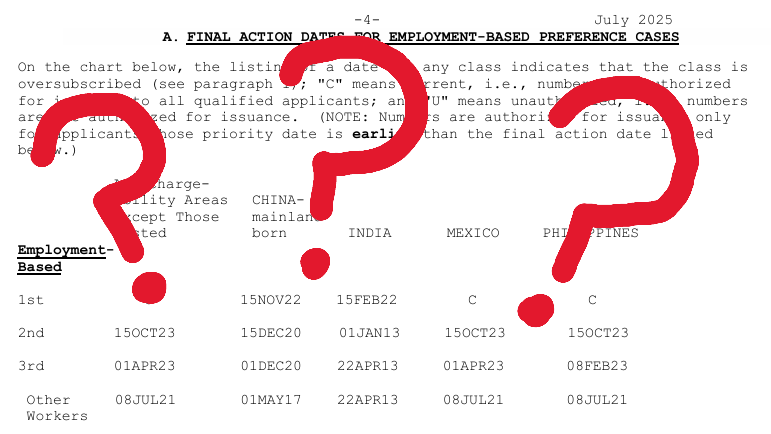
One trap for the unwary: the Visa Bulletin splits EB-3 into two lines that move independently. The main EB-3 line covers skilled workers and professionals, while a separate “Other Workers” (unskilled) line carries its own, usually much earlier, cut-off date. The two can diverge sharply in the same month and for the same country of birth. In the July 2025 Visa Bulletin, for example, the Rest-of-World and Mexico EB-3 skilled/professional line advanced nearly two months to April 1, 2023, while the Other Workers line for those same areas moved only about two weeks, to July 8, 2021. If your job was classified as “other worker,” you have to read the Other Workers row — reading the main EB-3 row will badly overstate how close you are to filing.
Family-Based Visas
Family-based visas are a cornerstone of the U.S. immigration system, enabling U.S. citizens and lawful permanent residents to sponsor close family members for immigrant visas. The Visa Bulletin plays a vital role in this process by providing monthly updates on the availability of immigrant visas in each family-sponsored preference category.
There are several family-sponsored preference categories, each with its own eligibility requirements and waiting periods. These include the F-1 category for unmarried adult children of U.S. citizens, F-2A and F-2B for spouses, children, and unmarried adult children of permanent residents, F-3 for married children of U.S. citizens, and F-4 for siblings of U.S. citizens. Each category is subject to annual limits, and the demand for visas often exceeds the supply, leading to waiting lists managed by the Department of State.
The Visa Bulletin’s final action dates chart is especially important for family-based immigrant visa applicants. It shows the priority dates that are currently eligible for final action, meaning applicants with a priority date earlier than the listed cut-off can move forward in the process. Understanding where your case falls in relation to these dates is key to estimating your waiting time and knowing when you can submit required documentation.
For family sponsored preference cases, tracking your priority date and monitoring the Visa Bulletin each month will help you stay informed about your place in line. The Department of State adjusts the final action dates based on the number of visas available and the demand in each preference category, so being proactive and staying updated is essential for all applicants seeking to reunite with family in the United States.
Final Action Dates vs. Date for Filing – Which One Matters for You?
The monthly Visa Bulletin always includes two key charts for each visa preference category: the “Final Action Dates” chart and the “Dates for Filing” chart. These charts are crucial for determining when applicants can proceed with their immigration applications.
Applicants can check the USCIS website to determine which chart applies for their filing in a particular month, as the DOS Visa Bulletin itself does not specify which chart to use. If USCIS determines there are more immigrant visas available for a fiscal year than there are known applicants for such visas, it will state on the USCIS website that you may use the Dates for Filing chart. Otherwise, USCIS will indicate that you must use the Final Action Dates chart to determine when you may file your I-485 Adjustment of Status application. If your particular immigrant visa category is “current” on the Final Action Dates chart or the cutoff date on the Final Action Dates chart is later than the date on the Dates for Filing chart, you may file using the Final Action Dates chart during that month.
Importantly, USCIS makes this call separately for family-sponsored and employment-based categories, and it can announce a different chart for each in the same month — so a family-based applicant and an employment-based applicant reading the same bulletin may be governed by different charts. USCIS re-issues this determination every month, so check its adjustment-of-status filing-charts page before you file.
The Final Action Dates Chart indicates when visas may be issued. The ‘final action date’ is the cutoff date that determines when an applicant’s priority date is current and they can proceed with the green card process. It shows the cut-off dates for visa numbers, meaning that only applicants with a priority date earlier than the listed date are eligible to have their visas processed to completion. Status applicants use the Final Action Dates chart to determine when they can file Form I-485. This chart is generally used to determine when an applicant can be scheduled for a consular interview or when their case can be finalized by the DOS or USCIS.
The Dates for Filing Chart provides the earliest dates when applicants may be able to submit their applications for adjustment of status. Adjusting status is the process by which eligible immigrants apply for lawful permanent residence when a visa becomes available. It allows applicants to assemble and submit required documentation if their priority date is earlier than the date listed on this chart. Adjusting status depends on the availability of immigrant visas, which is determined by the Visa Bulletin and priority dates. This chart is used when USCIS determines there are more immigrant visas available than there are known applicants, allowing for earlier filing.
What is Visa Retrogression?
Visa Bulletin retrogression occurs when the cut-off dates for visa availability move backward in time from one month to the next. This means that a priority date that was current in one month may no longer be current in the following month. When retrogression happens, only applicants with priority dates earlier than the new cut-off date remain eligible for visa issuance. Retrogression typically happens when the demand for visas in a particular category or from a specific country exceeds the number of visas available for that month.
Causes of Retrogression:
High Demand: Retrogression often occurs when there is a surge in demand for visas in a particular category or from a specific country, leading to more applications than there are available visas.
Annual Limits: Each visa category and country is subject to annual limits. When these limits are reached or are expected to be reached soon, retrogression can occur so that the government can manage the allocation of visas by cutting off new applicants. In an extreme case, a per-country allocation runs out entirely and the category is marked “Unavailable” until the fiscal year resets — as EB-2 India was in mid-2026.
Estimation Errors: The Department of State makes estimates of visa demand and availability. If these estimates are off, it can lead to retrogression as adjustments are made to align with actual demand.
A subtle but important point: retrogression can move the Rest-of-World cut-off backward even in a month when the most heavily backlogged countries, like China and India, show no change at all. Because their dates already sit many years in the past, they are insulated from the month-to-month swings that hit the “current” or near-current countries first.
Timing of Retrogression:
End of Fiscal Year: Retrogression is more likely to occur towards the end of the fiscal year (September), as the annual visa limits are approached and DOS adjusts the cut-off dates to prevent exceeding these limits.
Beginning of Fiscal Year: At the start of the fiscal year (October), a new supply of visa numbers becomes available, which often moves cut-off dates significantly forward again.
Visa Bulletin retrogression is a mechanism to manage visa demand and ensure compliance with annual limits. It is more likely to occur towards the end of the fiscal year (especially in the July, August and September Visa Bulletins) when visa numbers for that year are running low. Employment based adjustment cases can be particularly affected by retrogression, as their ability to proceed depends on visa availability.
Can You Time Your Case Based on This Month’s Visa Bulletin?
For much of the last decade the EB-2 India final action date has sat more than a decade in the past, and in the July 2026 Visa Bulletin the category reached its annual limit and went unavailable for the rest of the fiscal year. But assuming that a decade-plus backlog in the Visa Bulletin means that someone whose labor certification application gets filed today will also have to wait that long is wildly unrealistic — in either direction. The time it takes for a priority date to become current is influenced by multiple factors, and the backlogs in most categories have been increasing substantially over time.
Factors Affecting Wait Times:
Visa Demand and Supply: High demand in a particular category and limited supply causes the backlog to grow. Employment based preference visas are especially sensitive to fluctuations in demand and supply, as their allocation is managed through the Visa Bulletin process and subject to annual limits set by the INA.
Per-Country Limits: The Immigration and Nationality Act imposes a per-country cap, limiting the number of visas issued to people born in any single country. This can lead to longer wait times for applicants from countries with high demand, such as India and China in the employment-based categories and Mexico and the Philippines in the family-based categories.
Visa Retrogression: Sometimes, the cut-off dates in the Visa Bulletin move backward, a process known as retrogression. This can occur when the demand for visas exceeds the available supply, causing longer wait times.
Spillover Visas: Unused visas from other categories or countries can spill over to backlogged categories, potentially reducing wait times.
Policy Changes: Changes in immigration policy or legislation can also impact visa availability and processing times. For example, legislative changes that increase the number of available visas or alter per-country limits could affect wait times. Periods of high unemployment can also lead to more restrictive visa issuance policies or increased processing delays, particularly for employment-based preference visas, as economic downturns may influence both demand and government policy.
Surprise Factors: The last time that the Visa Bulletin progressed much faster than normal was triggered by the Covid-19 pandemic. The pandemic significantly impacted the Visa Bulletin by causing delays and backlogs in immigrant visa processing overseas that gave a short-term advantage to those applicants able to file I-485 Adjustment of Status applications from within the United States. These effects were due to the temporary suspension of routine visa services, reduced staffing, and operational constraints at U.S. Embassies and Consulates around the world.
In March 2020, the Department of State suspended all routine visa services, including the processing of applications for diversity visas, due to the pandemic. Only “mission-critical” visa services continued during this period. This suspension led to a significant backlog of visa applications, as many applicants were unable to proceed with their cases during the suspension period.
U.S. embassies and consulates faced staffing shortages and implemented social distancing measures. These constraints affected the ability to process visas at the usual pace, contributing to a temporary reduction in the number of immigrant visas issued.
With fewer visas being processed and issued abroad, the Department of State adjusted the Visa Bulletin to reflect the reduced demand for consular processing. This resulted in some categories advancing more quickly than usual, as the unused visa numbers were reallocated to other categories or regions. Many EB-2 and EB-3 applicants found their priority dates becoming current sooner than expected. Many applicants living in the United States were able to file their I-485 adjustment of status applications earlier than expected.
So, unexpected systemic disruptions like the COVID-19 pandemic can affect the Visa Bulletin and enable applicants to file their I-485 adjustment of status applications sooner than expected, or prevent applicants from getting their green cards as quickly as they had expected.
Estimating Your Wait Time
While the Visa Bulletin provides a snapshot of current backlogs, it is not a good predictor of future wait times. You can monitor the monthly updates to the Visa Bulletin to track changes in cut-off dates, but it takes deeper analysis to take into account how many people are ahead of you in your category, and how much the demand is outstripping supply in your category each year.
While a decade-plus backlog for EB-2 India in the Visa Bulletin suggests a significant wait for Indians starting their green card process now, it does not mean a new applicant will land in exactly that spot. Various factors, including visa demand, per-country limits, retrogression, spillover visas, policy changes, and even surprise factors like a pandemic or other significant consular disruption can influence how long it takes for a priority date to become current. Most experts agree that the Visa Bulletin backlogs in most categories will continue to balloon as demand outstrips a fixed supply that Congress hasn’t expanded in decades.
The Immigration Act of 1990 was the most recent significant legislative change that increased the overall number of green cards available. It established the current framework for employment-based and family-based immigration categories and set the annual limits — roughly 140,000 employment-based and 226,000 family-sponsored preference immigrants a year — that are still in place decades later. More recent legislation, including the 2025 budget reconciliation law, has changed filing fees and enforcement funding but did not increase the number of green cards Congress makes available each year. Staying informed about updates in immigration law is crucial, as changes can directly impact visa policies, wait times, and your ability to make informed decisions about your green card process.
Understanding the Diversity Visa Timeline
Reading the Visa Bulletin for Diversity Visas involves understanding how the U.S. Department of State allocates visa numbers to applicants selected through the Diversity Visa (DV) lottery. The Visa Bulletin provides information on the availability of visa numbers for DV applicants and indicates when they can proceed with their visa applications.
The Diversity Visa program, as outlined in the Immigration and Nationality Act, allows individuals from countries with low rates of immigration to the United States to apply for a visa. Each fiscal year, a certain number of applicants are selected through a lottery system.
The Visa Bulletin includes a section specifically for Diversity Visas, which lists the cut-off numbers for each region. These numbers indicate the rank of the last applicant who is eligible to apply for a visa in that month. The regions are divided into six geographic areas: Africa, Asia, Europe, North America, Oceania, and South America, Central America, and the Caribbean.
Each month, the Visa Bulletin publishes the cut-off numbers for each region. Applicants with a rank number below the cut-off number for their region are eligible to proceed with their visa applications. If an applicant’s rank number is above the cut-off, they must wait until a future month when their number becomes eligible.
Timing is critical for DV applicants, as they are only entitled to apply for visa issuance during the fiscal year for which they were selected. The Visa Bulletin helps applicants determine when they can submit their applications based on their rank number and the published cut-off numbers.
To read the Visa Bulletin for Diversity Visas, look at the section for Diversity Visas and check the cut-off numbers for your geographic region. If your rank number is below the cut-off, you can proceed with your immigrant visa application or I-485 Adjustment of Status application.
If you apply for a green card under the Diversity Visa (DV) program but it is not issued by the end of the fiscal year, you will lose your eligibility to receive the visa. The rules governing the DV program are strict, and the issuance of visas is bound by the fiscal year in which you were selected.
The Diversity Visa program operates on a strict fiscal year basis. According to U.S. law, diversity visa selectees must complete the visa issuance process by the end of the fiscal year for which they were selected. The fiscal year ends on September 30th. For example, the year of entitlement for everyone registered under the DV-2026 program ends as of September 30, 2026.
If a diversity visa is not issued by the end of the fiscal year, the applicant loses eligibility for that visa. This is an uncompromising deadline, and no visas can be issued after this date, regardless of the circumstances.
The law does not allow for extensions or exceptions to this deadline. Even if an applicant has submitted all required documents, filed a lawsuit, or obtained preliminary relief, they must receive the visa before the fiscal year ends. Otherwise, they are out of luck.
The same rules apply to spouses and children who are derivative applicants under the principal DV selectee. They must also receive their visas by the end of the fiscal year, or they will lose eligibility.
If a diversity visa is not issued by the end of the fiscal year, the applicant and any derivative family members lose their eligibility to receive the visa. The deadline is strict, and no exceptions are made. It is crucial for DV selectees to ensure that all steps in the visa process are completed in a timely manner to avoid missing this deadline, but even prompt action does not guarantee success.
Adjustment of Status
Adjustment of status is the process that allows eligible immigrant visa applicants already in the United States to become lawful permanent residents without having to leave the country. This process is overseen by U.S. Citizenship and Immigration Services (USCIS) and is a critical step for many seeking a green card through either family-sponsored or employment-based categories.
The Visa Bulletin is central to the adjustment of status process, as it determines when you can submit your application (Form I-485) and when your case can be approved. The two charts in the Visa Bulletin—the Application Final Action Dates chart and the Dates for Filing Applications chart—guide applicants on when to take action. The Application Final Action Dates chart indicates when an immigrant visa is actually available for your category and country, meaning your green card can be issued if your priority date is earlier than the listed date. The Dates for Filing Applications chart, when permitted by USCIS, allows applicants to submit their adjustment of status applications earlier, giving them a head start on gathering and submitting required documentation.
It’s important to check both the Visa Bulletin and the USCIS website each month to see which chart is being used for your category, as this can change depending on visa availability. Understanding the difference between these two charts and how they impact your eligibility to file is essential for anyone navigating the adjustment of status process. By staying informed and following the guidance provided in the Visa Bulletin, applicants can better plan their path to permanent residency and ensure they don’t miss critical filing windows.
About the Author
Loren Locke is the Managing Attorney of Locke Immigration Law and a former U.S. Foreign Service Officer who adjudicated approximately 12,000 visa applications at the U.S. Consulate in Mexico. She holds a J.D. from William & Mary Law School and a B.A. summa cum laude from the University of Richmond. Loren is regularly quoted on immigration policy by major publications including Newsweek, Condé Nast Traveler, and The Daily Mail, and specializes in EB-1A extraordinary ability petitions, O-1 visas, and National Interest Waivers.
Follow Loren on LinkedIn | Watch on YouTube | Book a consultation | hello@lockeimmigration.com
Want to learn how to strategically frame your achievements for the EB1A "Extraordinary Ability" visa? My free 5-day email course, "5 Days to Your Compelling EB1A Story," provides the 'EB1A Storytelling Toolkit' to help you build a powerful case. Sign up here.